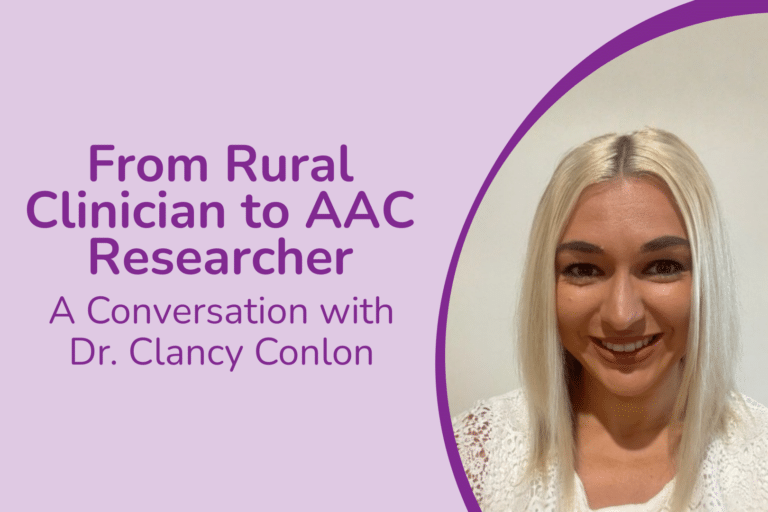
Dr. Clancy Conlon is a Speech Pathology Lecturer at CQUniversity, Rockhampton. She coordinates the AAC coursework and completed her PhD in 2025 exploring clinical competence in AAC. With experience across education and disability sectors, she also provides AAC services in under-resourced settings including Thailand and Fiji.
We sat down with Clancy to learn more about her journey from isolated rural clinician to passionate AAC researcher and educator, and to discuss her recent research on AAC training for Australian speech pathologists.
I’ve always loved learning and finding ways to grow my skills, so while working full-time as a speech pathologist, I decided to complete a Masters in Teaching. After that, I moved into a team leader role at a disability organisation, right around the time the NDIS rolled out in our area.
I’d always thought about doing a PhD, but as a rural clinician, I didn’t think there were many options. Then a position came up at CQUniversity here in Rockhampton, and I was encouraged to apply. The role came with the chance to teach AAC and do a PhD on any topic I wanted (including AAC) which was a huge drawcard. Honestly, I also needed a break from the NDIS world!
Now, I absolutely love academia. I studied at a regional university myself, so being able to give back and create opportunities for students from diverse backgrounds to become speech pathologists feels really meaningful. Regional universities play such an important role in shaping the profession, and I’m proud to be part of that.
As a clinician, I always worked with children with disabilities, including AAC communicators. In my early career, I was a rural clinician who had received very little AAC training at university, and at the time, there weren’t many options for professional development in my area—this was before online training became widely available.
It was a really isolating and confronting experience because I wanted to give my clients the best support possible, but it often felt like an impossible task. Over the years, I supported lots of students and new graduates who were going through the same thing, and I could see how widespread the issue was.
With the NDIS, the demand for clinicians experienced in AAC has grown significantly, but I don’t think universities have fully caught up yet. That gap sparked my PhD, which I completed in early 2025. My research focuses on AAC training for speech pathologists because I want to help ensure clinicians feel confident and equipped to support AAC communicators.
I think I could write an essay on this! One big lesson is that regional and rural clinicians have to be ultra-organised, multi-skilled, and almost able to ‘see into the future’—because they’re juggling so many different practice areas at once. AAC often makes up a small part of their caseload, so they don’t have the luxury of staying in one lane.
On top of that, professional development and resources are harder to access and often more expensive, and while online training is helpful, it can never fully replace face-to-face learning—which is even harder to get in regional areas.
So my biggest insight is this: be kind to yourself and to other speech pathologists while they’re learning. When someone takes a certain path or asks a certain question, you have no idea what their work context looks like. Kindness and understanding go a long way.
I’ve been really fortunate to provide AAC services in Fiji, where speech pathology is still an emerging profession and high-tech AAC isn’t easily accessible. One moment that really stuck with me was when I received a donation from Bridge Assistive for a 12-year-old client. Before that, she hadn’t been able to access any schooling.
With her new AAC system, she’s now able to engage with the Grade 1 and 2 curriculum. Seeing how that shifted the attitudes and beliefs of the people around her, about what someone with a disability is capable of, was incredible. That experience really drives me to keep working in this space because AAC can completely change lives, not just for the individual but for entire communities.
Interested in Clancy’s recent study on AAC training experiences of Australian speech pathologists? Check out this month’s Clinical Corner in our newsletter, or visit Clancy’s research profile at CQUniversity.
Want to connect with our team of AAC consultants? Contact us to discuss training opportunities, device trials, or AAC support services in your area.
Share this post: